During my third semester I have undertaken a research placement as an intern at the Organisation of Economic Co-operation and Development (OECD) in a National Urban Policy Unit. My internship has started a while before the semester (April 2025) and continues beyond it (until March 2026). However, this reflection essay is being completed as I approach the end of semester three at the beginning of December 2025 therefore my reflections, learnings and outcomes will relate to that nine-month period of my internship.
The unit under which I am completing my internship focuses on conducting analyses and dialogues between stakeholders regarding national level urban policies and their implications to the lower levels of governance (regions and cities). Therefore, my main activities in the unit included supporting creation of such analyses through desk research, participation in multi-stakeholder meetings as well as data and policy analysis. Throughout my internship I worked on three projects:
During my third semester I have undertaken a research placement as an intern at the Organisation of Economic Co-operation and Development (OECD) in a National Urban Policy Unit. My internship has started a while before the semester (April 2025) and continues beyond it (until March 2026). However, this reflection essay is being completed as I approach the end of semester three at the beginning of December 2025 therefore my reflections, learnings and outcomes will relate to that nine-month period of my internship.
The unit under which I am completing my internship focuses on conducting analyses and dialogues between stakeholders regarding national level urban policies and their implications to the lower levels of governance (regions and cities). Therefore, my main activities in the unit included supporting creation of such analyses through desk research, participation in multi-stakeholder meetings as well as data and policy analysis. Throughout my internship I worked on three projects:
(i) Shrinking Smartly and Sustainably: Small and Medium-sized cities in Portugal
Responsibilities: desk research of national policy framework, regional and city level urban development strategies, analysis of good practices in shrinking and ageing regions for sustainable development, analysis of population data and GIS mapping.
Outcomes: co-authorship of the report
Publication date: 21 October 2025
(ii) Unlocking the potential of intermediary cities
Responsibilities: desk research of national policy framework, regional and city level urban development strategies, analysis on the coverage and effectiveness of implemented policies/strategies based on publicly available data
Outcomes: ongoing project
(iii) Tackling Demographic Change in Regions: Thessaly, Greece and Norte, Portugal
Responsibilities: desk research of national policy framework, regional and city level urban development strategies,
Outcomes: ongoing project
Internship and Research placement goals
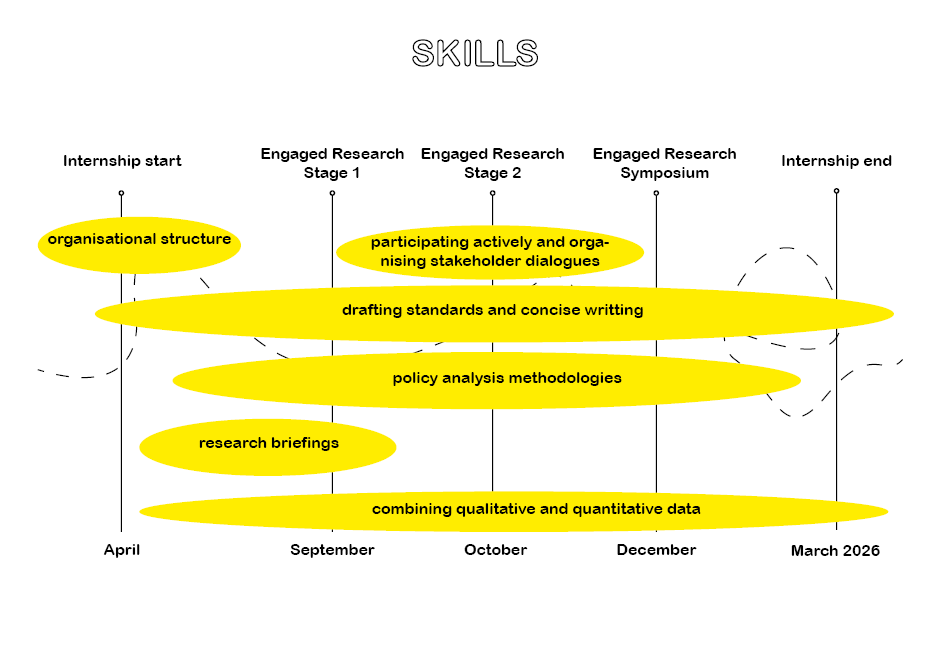
At the beginning of my internship, I did not have a chance to co-develop my goals for the internship with my supervisor which now I see as a disadvantage as it made it difficult to measure my progress. However, I have set my personal goals and areas of development which can be divided into skills and learnings (Table 1).
My placement started in April when my division (CITY) was organising first-ever urban conference (Urban Days) which gathered city, regional and national governments as well as researchers and academics to discuss the work of OECD on cities (its priorities, ongoing research projects, new emerging trends in urban planning and urban governance). It was an opportunity for me the closely listen and see which topics are of interest to me. It also gave me a good understanding what is the OECD’s relationship of different levels of governments. As an international organisation with permanent representation (delegations) of Member countries the work of the policy analysts and economics working there is in-between research as well as politics. It aims to use make data-informed decisions but also to convince and present data to the governments and allow them to adjust it to their own needs and contexts.
Later days and weeks of my internship were followed by getting to know the procedures and hierarchies of the organisation. I was assigned small research and drafting tasks on my first report “Shrinking Smartly and Sustainably: Medium and small-sized cities in Portugal”. There I received a lot of autonomy when it comes to drafting certain paper elements (describing and finding good practices of projects tackling demographic change in small and medium-sized cities in Portugal). I also had a chance to be given an equal voice in the discussion of the structure of the paper with my supervisor (David Burgalassi, a co-author of the paper). This gave me a lot of confidence especially being aware of my limited experience when compared to my supervisor when preparing policy papers.
After a period of focused and more individual work on policy paper on Portuguese cities experiencing demographic change, I was able to get engaged in another project in parallel on the potential of intermediary cities and their place in the national economic system. It was a great opportunity for me to work on two projects at the same time. I heave discovered how working on different projects is stimulating to me, especially in a very intellectually challenging work. It allowed me to re-use my already gathered knowledge on urban systems in Portugal into a different context. It also allowed me to gain experience in working in a bigger group on a project financed by the European Commission. Due to the complexity of the project and its financing source I was able to participate in various status calls with the Comission and support preparation of material and meeting notes that will influence the work of the entire team in the future. I participated in discussions on the context of the reports and case studies prepared as a part of the project (preliminary report, case studies and a synthesis report) which allowed me to understand how to receive feedback from a client on your work but also how to defer comments that one does not agree with and find a common ground where the values of both sides are somehow finding a satisfying compromise.
Towards September my organisation went through various organisational changes (mostly budget related) which were very eye-opening when it comes to how research institutions are financed and how the changing political landscape of influential countries (e.g. USA) can influence the type of research that is conducted and in what ways we conduct it. Due to the withdrawal of Americans from many international organisations the future of OECD activities also became more uncertain. Even tough it has not affected the projects I was working on, through conversations with my colleges I was able to see how research on climate change and mitigating inequalities is being underfunded or discontinued. The mere wording and description of research was seen as controversial, and it made me think about the temporality of language used in research related to cities and its relationship to the non-human world. Additionally, it made me realise how big scale research projects are being highly influenced by outside factors (elections, politicians) and how little power the individual researcher can have, and it requires institutional support to overcome those challenges.
The organisational and budget changes happening at my placement host’s organisation also influenced how I was supervised during the process. My initial supervisor has left the position, and I received a lot more autonomy and responsibility on the project we worked together before (policy paper on Portuguese small and medium-sized cities). I needed to coordinate the work myself and present my progress to the head of unit (HoU) which was not my supervisor on a day-t-day basis. This was a great learning experience as I was able to develop and present my leadership skills as well as learn how to receive feedback in a productive way instead of feeling discouraged. I was expecting that my HoU would not agree with everything I have prepared every time and that I still have a lot to learn about the standards of writing of the organisation as well as what kind of content I am being asked to produce. Multiple sessions with HoU on this project helped me to feel more confident with talking and presenting my point of view to senior management. Additionally, I was able to successfully lead a discussion about my place as a co-author of the policy paper. As I was removed as a co-author at some point of the writing process, I decided to discuss it with HoU, present my inputs as well as try to find a compromise that would both show my inputs but also accept the standards for acknowledgments in the organisation. In the end, I was credited with certain parts of the report which I contributed to the most (either through drafting or research, or both).
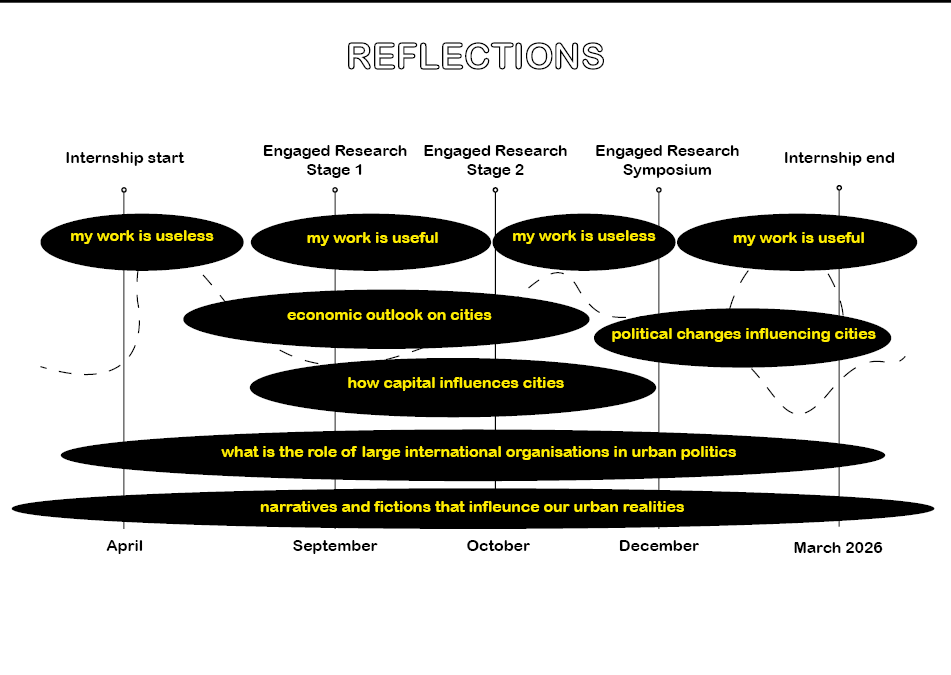
Throughout my placement I kept reflecting on the usefulness of my work at the OECD. As a research-based consultation institution (one of main goals of the organisation is to provide policy recommendation to different levels of the government). Working on various projects I started to think if the way of creating recommendations is not a bit too of a top-bottom process and also what is the point of the recommendations. I was able to discuss this topic with my new supervisor (Eleanor West) which helped me to understand how OECD can act as an intermediate body in-between different levels of government. Additionally, participation in policy seminar with stakeholder of different projects and one-day conferences allowed me to talk with government officials and understand how useful it is for OECD to act as an official (third) body and advocate on the behalf of lower levels of the governing system of a country. Through these events organised by the organisation as authors we were also able to discuss our findings and potential recommendation and receive feedback from the stakeholders that would be either influenced or engaged in implementing those changes. This helped to co-create recommendations based on data and qualitative analysis prepared by the research staff with realities of cities.
Relationship between me and the placement host
The project I decided to prepare as a part of the semester module was focused on my relationship with the placement host organisation and further on the relationship of urban planners and researchers to urban policy. As urban policies and governance started to be at the core of my work, I gained an interest in them and their influence on urban planners designs as well as everyday life of people living in those spaces. Before I started my internship, I had limited to no interest in diving deeper into urban policies and what impact they have on physical spaces. It seemed not related to my interest in archival works on cities, maps, mythologies and stories we tell ourselves about them. I became collecting visual representations of Cork which allowed me to create a framework that was using pre-modern way of depicting cities in contemporary planning (in the form of maps, planning documents). I was able to find a link between those only later in during my internship. I started to become more familiar with political science as well as economic theories which are guiding development of cities (especially in OECD member countries which are capitalistic democracies). I started to wonder how theories can guide real-life changes and became interested in this moment between the creation of a theory/a point of view and its physical manifestation.
This is when I decided to focus on research regarding speculative practices in urban planning. More specifically, on how financialisation of real estate markets influence cities. Through my work on Portugal on shrinking cities and the influence of the housing crisis on them I became familiar with anti-speculation policies (land re-adjustment, infrastructure levy etc.) (OECD, 2022). My later engagement in the project on demographic change in Thessaly region in Greece also made me aware of how governments use financialisation, upselling and privatisation of public services (especially when it comes to land) in the times of economic crises (Greece’s economic (started in 2009). In my project I decided to focus on how economic situation can condition and “produce” the urban space. This focus came from my understanding how little I knew about anti-speculation urban policies and how they are not common knowledge of urban designers and researchers (something I discovered in my peers). As a part of my research project I decided to gather the knowledge on existing policies (good practices) that are used around the world to help keeping the land prices low and therefore support housing affordability. At the same time I wanted to make this knowledge more accessible (for urban partitioners but also other interested people) hence I decided to create a quiz where I would translate the policies’ characteristics into human ones (a system often used in myths and stories) and allow people to gain a better understanding of the policies through creating a more intimate learning experience. Below you might find the link to the quiz and find out which of the anti-speculation policies suits your personality best (mine is land re-adjustment!):
Applying knowledge, skills and competencies acquired during RePIC
Throughout my internship and preparation of my research project and reflection I have translated my interest in mythologies and theory which I was able to develop during the third semester of RePIC during my work on medieval maps of Cork. I improved my understanding on urban studies theory (through the module on the theory of urban studies) which helped me to make connections between more practical parts of my work (creating analyses of policies) and abstract ideas (mythologies). This module also helped me to understand my own positionally within a larger system of the organisation as well as the organisation’s position in the world and its impacts on cities and people. Advancing my skills in the Digital Storytelling module helped me to create the website that acts as the report (and where you are now dear reader) hence improving the visual representation of my work making it more accessible and fun to read, I hope! The previous semesters (especially semester 1) helped me to gain skills which I later used in my work (like preparing QGIS maps and concise writing). In the end my essay from semester 1 acted as a writing sample in the recruitment process for the internship.
The final reflection
Looking back at the list of skills and learnings I was hoping to achieve (Table 2.) I was able to achieve most of them. After 8 months of my placement at the OECD I was able to develop much better writting skills (writting in concise and plain English) and ability to structure longer papers. My skills in research have also improved significantly and I was able to filter only relevant information for a given topic of a report or a paper (instead of putting all information I would interesting which I did before). In this regard coaching of my supervisor Eleanor but also HoU (Tadashi) was crucial as they provided me with feedback on the lengths of my research notes and drafting skills. I also improved my ability to work in a team and research environment which I had no experience before. I found it very satisfying and interesting and hope to continue to work that way in the future.
These months have helped be to identify my weaknesses as well. Sometimes additional areas in which I would like to improve and do more work around. These are especially data analysis skills as well as understanding of different styles of governance around the world (especially relating to cities). I was not able to do much work in the data analysis part as I lack the skills and was surrounded by many well-skilled data analysts. However, I would like to work on those skills in the future especially when it comes to GIS analysis, map creation and data visualisation (presenting research in a clear and captivating way) in QGIS, ArcGIS and R. I would also like to improve my confidence and focus at work which were challenging when working in-between the institution and university.
As I was reflecting on my experience as an intern at the OECD I also found that I was lacking a focus on historical context and analysis which led to the development of certain policies. Since the organisation os focusing on what is happening now and how we can support future changes I believe that it would benefit greatly by looking into the historical conditions of the countries, cities and urban governance. This is why I decided to take my learnings, skills and interested related to urban policy gained during this semester, my reflection regarding it and a need for historical analysis and combine it in my masters thesis which I will be developing next semester (spring-summer semester of 2026). There I plan to focus on the analysis of knowledge production sourrounding urban planning reforms in the transformation period (1989-2005) in post-socialist countries. I aim to use comparative policy which I used often during my internship, historical interested (developed during semester 2) and the need for understanding the urban space that was surrounding me when I lived in Poland (exploring my local context in a wider context which can provide insights for other countries undergoing large urban transformations).
The final final reflection
Over the course of the last 8 months I found my research placement very stimulating and formative when I think of my future work. It allowed to make a link between my interest in politics (exhibiting in my immense interest in the interest in international politics podcasts) and my studies. I have grown as a researcher and as a person (having experienced living in Paris and its chaos!) and found myself among very intelligent colleagues who’s hot takes and knowledge made the one-hour lunch break go especially fast.
Even tough I was not able to achieve all of my goals I was able to identify the gaps and places of improvement which I would like to focus on in the last semester and over the course of my career in general. Interning at the OECD also helped me to visualise how urban research can be ustalised in the real-world and what kind of impact it might have.
I am continuing the internship until the end of March 2026 so my work will continue and this reflection does not fully reflect the entire duration. I hope my learnings will only improve and I’ll have more possibility to propose certain approaches to projects or even projects which can be co-developed with my supervisors. I found it very useful that my placement extended over the period of the semester and I was able to really delve into the projects and receive tangible outcomes (e.g. co-authorship on one of the reports).
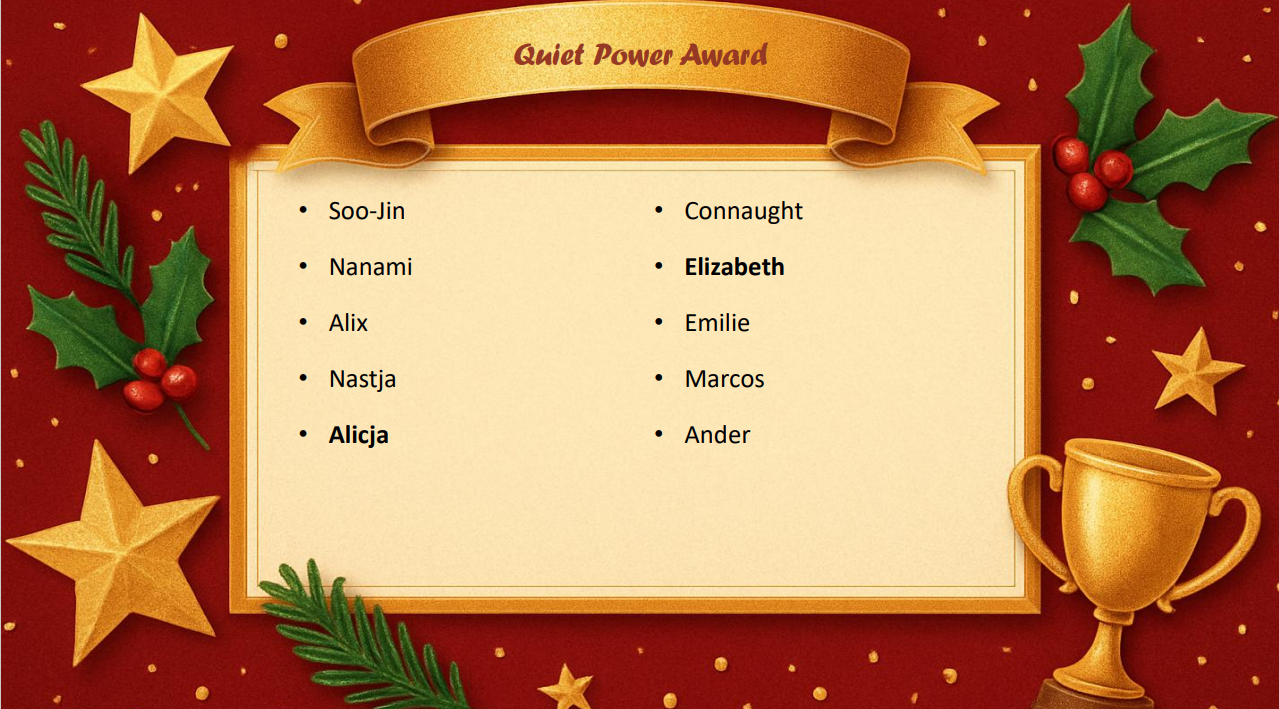
P.S. As I am finishing writing this reflection essay I have received news from my placment host organisation that I have won in the annual employee awards in the following categories:
1. The Quite Power.
2. Walking Wikipedia.
I would like to add those achievements to the list of already mentioned skills and learnings gained.